Carl Franz Anton Schreibers
Carl Franz Anton Schreibers
Beyträge zur Geschichte und Kenntniss meteorischer Stein- und Metal-Massen, und der Erscheinungen, welche deren Niederfallen zu begleiten pflegen., 1820
3050-BK
15 5/8 x 11 in. (40 x 28 cm)
Price Upon Request
Carl Franz Anton Schreibers
Beyträge zur Geschichte und Kenntniss meteorischer Stein- und Metal-Massen, und der Erscheinungen, welche deren Niederfallen zu begleiten pflegen., 1820
3050-BK
(40 x 28 cm)
Vienna: Verlage von F. G. Heubner, 1820. First edition of the earliest iconography of meteorites with eight lithographed plates (one folding and another partly hand-colored), an engraved strewn field map, perhaps the first ever such map, showing not only the location of all of the 63 fragments, but the names of the villagers who collected them, including one remarkable plate—an impression taken directly from a meteorite that fell in about 1400, the first use of a mineral in nature printing. The Elbogen meteorite (as it is known, Elbogen being the German name for the village of Loket, today in the Czech Republic) is an exciting exception, being quite large (about 236 lb./170 kg). Fortunately, be it due to local superstition or awe, the stone was preserved. Pieces of it were distributed to museums around the world for scientific study. The biggest segment is deposited in the Naturhistorisches Museum in Vienna, weighing roughly 80 kilograms (180 lb.). It is there that the Austrian mineralogist, Count Alois von Beck Widmanstätten, encountered the rock. Intrigued, in 1808, he discovered that a sliced iron-rich meteorite could be etched with acid to reveal a distinct pattern (now known as the Widmanstätten pattern). This pattern could be recorded on paper by inking and printing directly from the etched meteorite surface. This book is the first ever to describe a particular meteorite collection. It has some of the most arresting images anywhere of recorded meteorites, including the double- page plate that opens the book, displaying the 86-pound chunk of iron that fell in Hraschina (Hrašćina), Croatia, on May 26, 1751. The images in the book were printed by lithography, which was invented around 1800; it may indeed be the first geology book anywhere to be illustrated with lithographs. And it revealed that when an iron meteorite is heated in a flame, or rinsed with acid, it reveals a distinctive pattern, known as a Widmanstätten pattern, that only appears on meteorites. Alois Widmanstätten had discovered this some years earlier (and was not in fact the first to do so), but most geologists learned about Widmanstätten patterns from a plate in von Schreibers’ book that was actually printed directly from an etched meteorite. Karl Franz Anton Ritter von Schreibers, an Austrian naturalist, was born Aug. 15, 1775. Although trained as a physician, von Schreibers took all of nature as his province, which made him the ideal choice to assume the directorship of the Vienna Natural History Museum in 1806. Although he was competent as a zoologist and botanist, his true love was minerals, and especially meteorites. The Vienna museum had been collecting meteorites since the 1740s, but it wasn't until the turn of the 19th century that scientists were finally convinced that meteorites were not some sort of atmospheric debris, but came to earth from deep space. Ref: Fischer No. 22, and Dr. William B. Ashworth, Jr., Consultant for the History of Science, Linda Hall Library and Associate Professor, Department of History, University of Missouri-Kansas City.
Price Upon Request
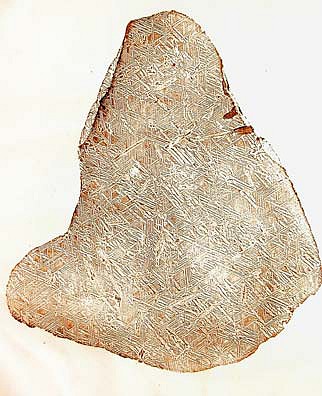
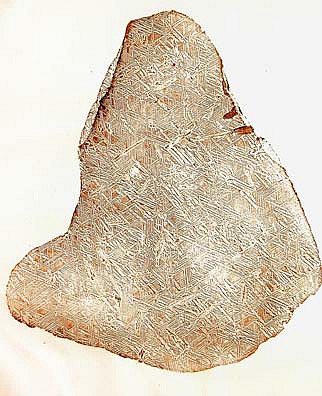
Vienna: Verlage von F. G. Heubner, 1820. First edition of the earliest iconography of meteorites with eight lithographed plates (one folding and another partly hand-colored), an engraved strewn field map, perhaps the first ever such map, showing not only the location of all of the 63 fragments, but the names of the villagers who collected them, including one remarkable plate—an impression taken directly from a meteorite that fell in about 1400, the first use of a mineral in nature printing.
The Elbogen meteorite (as it is known, Elbogen being the German name for the village of Loket, today in the Czech Republic) is an exciting exception, being quite large (about 236 lb./170 kg). Fortunately, be it due to local superstition or awe, the stone was preserved. Pieces of it were distributed to museums around the world for scientific study. The biggest segment is deposited in the Naturhistorisches Museum in Vienna, weighing roughly 80 kilograms (180 lb.). It is there that the Austrian mineralogist, Count Alois von Beck Widmanstätten, encountered the rock. Intrigued, in 1808, he discovered that a sliced iron-rich meteorite could be etched with acid to reveal a distinct pattern (now known as the Widmanstätten pattern). This pattern could be recorded on paper by inking and printing directly from the etched meteorite surface.
This book is the first ever to describe a particular meteorite collection. It has some of the most arresting images anywhere of recorded meteorites, including the double- page plate that opens the book, displaying the 86-pound chunk of iron that fell in Hraschina (HrašÄ‡ina), Croatia, on May 26, 1751. The images in the book were printed by lithography, which was invented around 1800; it may indeed be the first geology book anywhere to be illustrated with lithographs. And it revealed that when an iron meteorite is heated in a flame, or rinsed with acid, it reveals a distinctive pattern, known as a Widmanstätten pattern, that only appears on meteorites.
Alois Widmanstätten had discovered this some years earlier (and was not in fact the first to do so), but most geologists learned about Widmanstätten patterns from a plate in von Schreibers’ book that was actually printed directly from an etched meteorite.
Karl Franz Anton Ritter von Schreibers, an Austrian naturalist, was born Aug. 15, 1775. Although trained as a physician, von Schreibers took all of nature as his province, which made him the ideal choice to assume the directorship of the Vienna Natural History Museum in 1806. Although he was competent as a zoologist and botanist, his true love was minerals, and especially meteorites. The Vienna museum had been collecting meteorites since the 1740s, but it wasn't until the turn of the 19th century that scientists were finally convinced that meteorites were not some sort of atmospheric debris, but came to earth from deep space.
Ref: Fischer No. 22, and Dr. William B. Ashworth, Jr., Consultant for the History of Science, Linda Hall Library and Associate Professor, Department of History, University of Missouri-Kansas City.